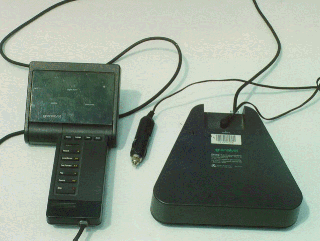
A BMW owner found this in his car. Was this made by the same VR that makes our beloved V1?


|

|

|
|
|


 Same VR?
A BMW owner found this in his car. Was this made by the same VR that makes our beloved V1?
Re: Same VR?
Yes it is. Its called a G analyst. They are sometimes on ebay for $200. None on there right now though.
http://mrganalyst.typepad.com/mr_gan..._manual_v2.pdf
Re: Same VR?
Originally Posted by v1user

That g-analyst looks nothing like the emissions controller box in the original post...
Re: Same VR?
I've used a g-analyst and it's different from the pic I posted. Here's a pic of like the one I used:
The pic I posted earlier seems to be some sort of emissions diagnostic tool. According to the owner, it's a go between controller for the O2 and MAF.
Last edited by Blown Z; 01-17-2010 at 09:39 PM.
Re: Same VR?
Oops. Its bksnoopy causing me to think like that.
There is just so little on the net about VR's other products they've made in the past.
Has CMG called VR for info?
[ame=http://forums.bimmerforums.com/forum/showthread.php?t=1370872]Old School Euro Bimmer topic- Valentine Research Feedback Emissions Compliance... - Bimmerforums - The Ultimate BMW Forum[/ame]
Last edited by v1user; 01-17-2010 at 12:26 AM.
 Re: Same VR?
http://members.rennlist.com/pirtle/zfi_bosch_brains.txt
Car and Driver May 1985 has an article on Mike Valentine (radar detector
guy) cracking the Bosch brain code. He did to get a Gray Market BMW to pass
Federal Emissions testing.
"From being interested in Porsches, I kinda knew how Bosch fuel injection
works. Basically the fuel is supplied at constant pressure. For each
cylinder there is a solenoid injector. How much fuel goes in is determined
by how long an electrical pulse the injector gets. And that's the brain's
job. But where does the brain get its information? You're not supposed to
pry the top off the airflow meter. But I did it anyway. Inside there's a
flap in the airstream pivoting on a shaft. It's held shut by a cuckoo-clock
spring. When air comes in, it blows open the flap, kinda like a screen door
with no latch. And the harder it blows, the harder the door goes out against
the closing spring. On the shaft is a potentiometer. Looks like a volume
control on a radio. As soon as any electronics buff sees that, it's 'Aha!
Now I see where the signal comes from.' It's like an air-volume knob. The
more air coming through, the louder it turns up the knob. That's easy. So I
was poking around the engine compartment with my oscilloscope. Hook up an
injector wire, then play with the throttle and see what happens to pulse
width. The brain is responsible for holding idle speed steady. When I pushed
the flap to lean it out, the rpm would drop and the brain would say, 'Hey,
it's slowing down, we gotta richen this beauty back up,' and the pulse width
would go up. You could push the flap around, and the idle speed wouldn't
change at all. The brain would fight until you got completely outside its
tolerance limits."
Valentine concluded that the only way to deal with a Bosch brain was to
think like Bosch brain.
"Since the brain determines the mixture, I had to figure some fake-out, some
way to send it bogus information so it would make EPA mixture instead of
German-market mixture." (Or in our case max hp mixture.) "I found that the
brain sends a constant reference signal to the potentiometer on the airflow
meter. the meter processes the signal according to how much air is going
into the engine and sends the manipulated signal back to the brain. Out the
other side of the brain goes the signal to the injectors telling them how
long to stay open. If you think about the problem, you realize that you want
to add fuel in percents rather than increments. One increment at full
throttle may not be very much, but the same increment at idle may drown it.
So the input side is the right opening. If you fiddle with the reference
going into the airflow meter, then everything coming out is proportional to
the airflow.You want to find the leanest part of the map; that's probably
going downhill with the throttle just cracked open. And the richest part;
that should be cold starting. Then if you can add or subtract from the
reference to get the mixture right in those two extremes, that's all the
voltage you'll ever need. And this establishes the limits for the control
circuit you're going to build. Then you work out the in-between points. If
it's lean at part-throttle cruise, just how lean is it? I figured this out
on the road, running on cruise control. I had a stack of batteries and a
bunch of resistors on a board. And some wires into the passengers
compartment from the fuel injection. Then with a meter hooked up to he
oxygen sensor, I could tap around on the battery stack until I found a
control voltage that would make it go rich.The only anomaly I ever found was
25% rich then stomping on full throttle. The signal back to the brain was
higher than the reference, and it hadn't been taught to think about that. So
it crashed. There's really not too much to the circuitry. There are some
operational-amplifier chips and some little decision-making circuits called
CMOS analog switches. You need a loop amplifier for stability. And, of
course, a box and connectors and stuff. You get out your semiconductor
catalogs and try to find things that don't cost $30 apiece. you can't quite
buy all of this from Radio Shack, but it's close, just the barest level
above. For the prototype, in fact, I got about 75% of what I needed from
Radio Shack."
Valentine has adapted his box to work on other BMW models, including the
M635 and the Alpina B6, as well as the Porsche 911 with Motronic II, and
even the Porsche 928 with the hot-wire airflow meter.
Re: Same VR?
thanks for sharing the info. Especially for taking the time for the long post.
Re: Same VR?
Thanks for the info Jim! Does anyone know about other cool gadgets that VR made?
Last edited by Blown Z; 01-17-2010 at 05:37 PM.
 Posting Permissions

 Reply With Quote


Bookmarks